

PenCom Begins Review of Pension Reform Act 2014
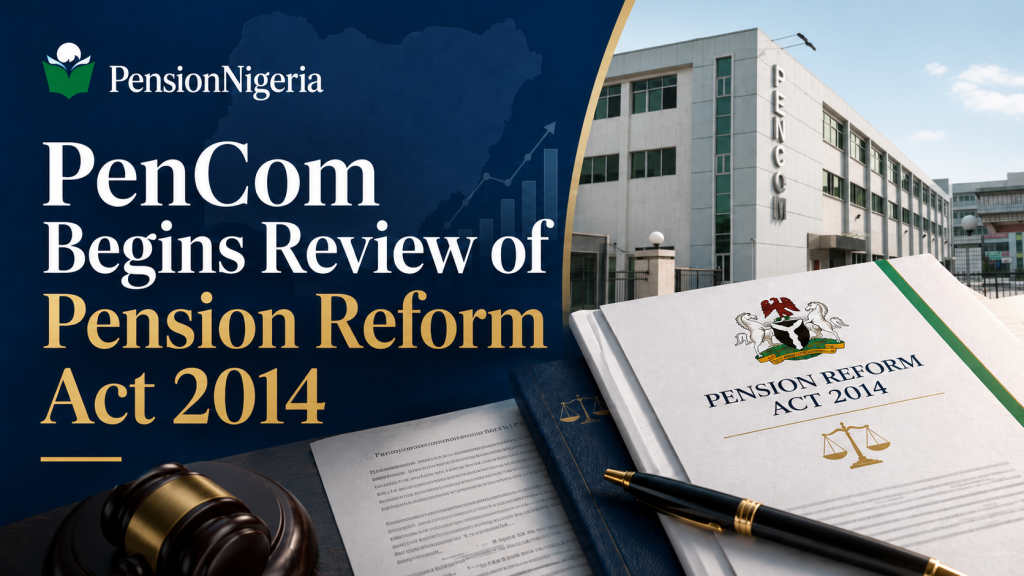
The National Pension Commission has commenced a comprehensive review of the Pension Reform Act 2014, opening the way for what could become the most significant change to Nigeria’s pension legislation in more than a decade.
The Director-General of PenCom, Ms Omolola Oloworaran, disclosed the development during the third meeting of the Pension Industry Leadership Council held in Abuja recently. According to her, the review is intended to modernise the legislation, address gaps identified during its implementation and improve retirement outcomes for Nigerian workers and pensioners.
The Pension Reform Act 2014 currently provides the principal legal framework for the administration of pensions in Nigeria. It established and strengthened the Contributory Pension Scheme, regulates the registration and funding of Retirement Savings Accounts and defines the responsibilities of employers, employees, Pension Fund Administrators, Pension Fund Custodians and PenCom.
Why PenCom Wants the Act Amended
Explaining the reason for the review, Oloworaran said economic, financial, technological and social conditions had continued to change since the Act was enacted 12 years ago. She stated that the purpose of the review was to ensure that the pension law reflects present-day realities and provides adequate legal support for reforms being introduced by the Commission.
PenCom has also identified implementation weaknesses that could not be fully addressed through regulations, circulars and administrative guidelines alone. The proposed amendment is therefore expected to strengthen the legal foundation of the pension system and remove provisions that may no longer adequately respond to current industry conditions.
The Commission has not yet released the specific sections of the Act that it intends to amend but the DG disclosed that consultations with relevant stakeholders were still ongoing and assured contributors and retirees that the proposed changes would be designed to improve their welfare.
Pension Industry Has Changed Significantly Since 2014
Nigeria’s pension industry is considerably larger and more complex than it was when the current Act was enacted. Total pension fund assets reached approximately ₦31.32 trillion as of May 2026 compared to about ₦4.61 trillion as at 31 December 2024, representing a significant increase from the size of the industry in 2014. The number of registered pension accounts has also risen to more than 11 million, making the pension industry one of the largest pools of long-term domestic capital in Nigeria.
The growth in pension assets has been accompanied by new challenges involving inflation, investment returns, digital pension administration, cybersecurity, informal-sector coverage, employer compliance, delayed remittances, retirement benefit adequacy and the use of pension funds for long-term economic development.
These developments provide a strong basis for reviewing legislation drafted for an industry that was much smaller and less technologically advanced 12 years ago.
Possible Areas the Review May Address
Although PenCom has not published the proposed amendments, recent policies and public statements from the Commission provide some indication of the issues that could attract legislative attention.
1. Improving Retirement Benefits
One of the most important questions facing Nigeria’s pension system is whether the income received by retirees is sufficient to maintain a reasonable standard of living, especially during periods of high inflation.
PenCom has said that its reform initiatives are focused on putting more money in the hands of retirees and enabling workers to retire with greater financial security. The review may therefore examine provisions affecting programmed withdrawals, annuities, pension enhancement, minimum pension guarantees and the general adequacy of retirement benefits. But it is necessary to note that any amendment in this area would need to balance the immediate financial needs of retirees against the risk that excessive lump-sum withdrawals could cause individuals to exhaust their pension savings too early.
2. Strengthening Enforcement Against Defaulting Employers
Failure by some employers to deduct and remit pension contributions remains a major challenge under the Contributory Pension Scheme. PenCom has intensified its collaboration with law-enforcement agencies to recover unremitted contributions and prosecute non-compliant employers. The Commission has worked with the Independent Corrupt Practices and Other Related Offences Commission and has announced plans to deepen enforcement cooperation with the Economic and Financial Crimes Commission.
The amended Act could introduce stronger sanctions, faster recovery procedures and clearer personal liability for directors or principal officers of organisations that deduct pension contributions from employees’ salaries but fail to remit the money into the employees’ RSAs. It may also be necessary to review existing penalties, some of which may have been weakened by inflation and the changing value of money since 2014.
3. Expanding Pension Coverage
Despite the growth of the Contributory Pension Scheme, millions of Nigerians, particularly those working in the informal sector, remain outside the formal pension system. PenCom is currently promoting the Personal Pension Plan as a more flexible means of providing pension coverage to self-employed workers, traders, artisans, transport workers, professionals and people earning irregular incomes. However, participation remains below the Commission’s target.
The amendment may provide stronger incentives for participation, simplify enrolment requirements and create a more suitable legal framework for workers whose earnings do not follow the conventional monthly salary structure.
4. State Government Participation
PenCom has disclosed that only eight states had fully implemented the Contributory Pension Scheme as of July 2026, while two other states were reportedly close to full implementation. The low level of implementation across the states exposes many public-sector workers to uncertainty over how their pensions will be funded and paid after retirement.
A review of the PRA could seek to strengthen coordination between federal and state pension systems. However, because state governments have constitutional and legislative responsibilities over their employees, achieving nationwide implementation may require cooperation between PenCom, state legislatures and state governments rather than relying solely on amendments to the federal Act.
Possible reforms could encourage states to establish dedicated pension funds, adopt irrevocable payment arrangements and prevent accumulated pension liabilities from being passed from one administration to another.
5. New Investment Opportunities and Infrastructure Financing
Pension funds are intended to be invested primarily in the interests of contributors and retirees. At the same time, their long-term nature makes them potentially suitable for financing infrastructure and other productive investments. PenCom has been working to expand the range of investment instruments available to PFAs, including commercially viable infrastructure projects, private equity and other alternative assets capable of providing competitive long-term returns.
The Commission has also indicated that the proposed Pension Industry Infrastructure Fund is at an advanced stage and has introduced discussions around liability-driven investment strategies designed to match pension assets more closely with future benefit obligations.
The review may therefore consider whether the existing Act provides sufficient flexibility for innovation in pension fund investment while maintaining strong safeguards against political interference, concentration risk and the use of workers’ retirement savings for uncommercial projects.
However, any amendment must preserve the fundamental principle that pension assets belong to contributors and must be invested solely under prudent, transparent and commercially sound conditions.
6. Technology, Data Protection and Cybersecurity
Pension administration has become increasingly digital since 2014. RSA registration, data recapture, account transfers, benefit processing, compliance certification and customer service now depend heavily on digital platforms. This digital transformation has created a need for stronger provisions relating to cybersecurity, data protection, electronic records, digital identity verification, fraud prevention and operational resilience.
PenCom’s September 2025 capital requirements circular specifically identified technology, cybersecurity and the growing complexity of pension operations as reasons operators require stronger financial capacity. An updated Act could give clearer statutory recognition to electronic pension transactions and impose more explicit obligations on operators regarding data security and business continuity.
7. Capital Requirements and Industry Consolidation
PenCom increased the minimum capital requirement for PFAs in September 2025. PFAs with assets under management below ₦500 billion are required to maintain a minimum capital base of ₦20 billion, while those managing ₦500 billion and above must maintain ₦20 billion plus one per cent of the amount by which their assets exceed ₦500 billion. Pension Fund Custodians (PFC) are required to maintain ₦25 billion plus 0.1 per cent of assets under custody. Existing pension operators are required to comply with the revised capital requirements no later than 30 June 2027. The recapitalisation is expected to encourage capital injections, mergers and possible acquisitions within the pension industry.
The amendment could clarify and or emphasis PenCom’s powers over recapitalisation, mergers, acquisitions, transfers of pension assets, resolution of distressed operators and the protection of contributors when a licensed pension company is acquired or ceases operations.
8. Governance and Consumer Protection
The growth of the pension industry has increased the need for stronger governance, transparency and accountability. Possible amendments could cover the composition and responsibilities of the boards of pension operators, conflict-of-interest rules, related-party transactions, disclosure of investment performance, customer complaint resolution and penalties for misleading contributors.
There may also be a case for clearer service standards governing benefit processing, customer communication, account transfers and the correction of incomplete or inaccurate RSA records.
Required Approvals to Amend PRA 2014
PenCom can initiate the review and prepare recommendations, but it cannot amend the Pension Reform Act on its own.
The proposed changes will ultimately have to be presented as an amendment bill and passed by the Senate and House of Representatives. After passage and harmonisation by both chambers of the National Assembly, the bill would require presidential assent before becoming law.
The review is therefore still at an early stage. Stakeholder consultations, preparation of the amendment bill, legislative hearings and consideration by the National Assembly may take place before the final provisions become known.
Conclusion
The decision to review the Pension Reform Act 2014 is long overdue, the first Pension Act was 2004, second was 2014, third should have ordinarily been 2024 but now its perhaps 2027 that we will get a new Pension Reform Act.
Nigeria’s pension industry has expanded into a ₦31 trillion sector, but the system continues to face challenges involving limited coverage, low pension literacy, employer defaults, inflation, benefit adequacy, state government participation and the need for safe long-term investment opportunities. A carefully designed amendment could strengthen the Contributory Pension Scheme, improve enforcement, expand coverage and produce better retirement outcomes.
However, the success of the exercise will depend on transparency, broad stakeholder consultation and the preservation of the central principle of pension administration. Until the proposed amendments are officially released, discussions about the likely changes remain informed projections rather than confirmed provisions of the new law.
Be the First to Know – Follow PensionNigeria WhatsApp Channel Its Free – Click here to follow our WhatsApp Channel
Support PensionNigeria
Support PensionNigeria financially with N1,000 per Month HERE, or with any amount ONCE (One Time Only) HERE
Empower us to do more independent analysis of the Pension Industry in Nigeria
Be the First to Know – Follow PensionNigeria WhatsApp Channel
Its Free – Click here to follow our WhatsApp Channel
Don’t Miss Anything Subscribe to PensionNigeria Newsletter on Substack
Once you Subscribe, we immediately send you an Email.
Please check your Inbox and SPAM folder.
If the Email is in your SPAM folder, kindly move it to your Inbox and add pensionnigeria@substack.com to your address book or contacts.
If you have subscribed before and you still do not receive our Newsletter,
please check your “Spam Folder”, if you find our Newsletter there, mark it as “NOT SPAM” or move it to your Inbox
Check here for Recent PensionNigeria Newsletter
Follow PensionNigeria on Social Media
Like our Facebook Page
Follow us on Twitter, Instagram & LinkedIn
Subscribe to our Channel on YouTube
Grow Your Personal Investment with Stanbic IBTC Asset Management


Pension is Your Right,
An Insurance for Old Age
Follow PensionNigeria on Social Media LinkedIn Twitter Instagram Facebook YouTube